

• Home
  • About
  • Archives
  • Authors
  • Contact
  • Polls
  • Small Biz Interviews
 

Archive for the ‘Small Business’ Category

Untapped Potential in and around the Capital: How the GWR can catch up to Silicon Valley

Thursday, February 16th, 2012

When it comes to entrepreneurial success in technology, everyone thinks of Silicon Valley. The irony here is that, in spite of its highly entrepreneurial and technology-savvy environment, the Greater Washington Region (GWR) has not been able to catch up with Silicon Valley. This issue has perplexed many people in the GWR and spurred them to try and bridge this entrepreneurial gap. However, some things are not so easy to solve, and this conundrum has many different angles to it. Luckily, Amplifier Ventures’ own Jonathan Aberman, who is also co-chair of Startup Virginia and president of FounderCorps, has developed a report on the GWR and how it fares in surpassing Silicon Valley as the center of technology entrepreneurship.

Another Way

As Aberman discusses, businesses within the GWR have tried to understand why Silicon Valley remains at the helm of technology entrepreneurship. Like most of us, these businesses have looked towards the everlasting concept: To defeat your opponent, you must become your opponent. Such thoughts have led many to consider one of two options on how the GWR can become the new Silicon Valley:

1)      We can mimic Silicon Valley’s infrastructure by fostering particular aspects of its entrepreneurial demographic such as its capital and workforce.

2)      We can adopt the cultural mentality of Silicon Valley by creating a greater sense of connection and support amongst the entrepreneurial community.

Although these are good ideas, Aberman sees fault in how the supporters of these theories are viewing the issue at hand. No two people are alike, so we can hardly expect that two separate regions can be the same. Aberman feels that we cannot look for patterns that contribute to Silicon Valley’s entrepreneurial success just so we can copy it. Rather, he believes we must utilize these observed patterns in a way that caters to the GWR’s own unique infrastructure and culture. This being said, Aberman proposes that the GWR’s solution to overtaking Silicon Valley lies in mergers and acquisitions.

The Hard Facts

Of course, nothing changes if a proposal has no foundation. That is why Aberman has provided a convincing series of facts regarding M&A in both the GWR and Silicon Valley. Aberman examines the Financials, Healthcare, High Technology, Industrials, Media and Entertainment, and Telecommunications industry sectors of both regions from 2007 to 2011 in order to find substantive evidence to his claim.

Across these technology-intensive sectors, two particular points stick out. First of these is the difference in the amount of each regions’ local acquisitions. Of the acquired Silicon Valley companies between 2007 and 2011, approximately 45% were bought up by local firms. On the other hand, only around 37% of GWR companies were acquired by firms in the same region. The second point that deserves attention is the diversity of acquisitions among the various sectors. Silicon Valley saw around 64% of its acquisitions in High Technology. Although this is the same sector that the GWR had the majority of its acquisitions in, it was only around 37%. This means that, despite both regions focusing on High Technology, the GWR was much more diversified amongst the sectors.

What does it Mean?

From the differences in local acquisitions and the amount of diversity across the sectors, Aberman demonstrates his opinion of the issue at hand. By experiencing almost half of its acquisitions locally, Silicon Valley is essentially recycling its own resources. Beneficial assets such as innovative ideas, patents, and knowledgeable workers are not leaving Silicon Valley, but staying together. This consolidation allows for acquiring companies to gain valuable products and services from others with the same regional mindset, ensuring that the acquisition itself will be smoother.

On the other hand, Aberman explains that Silicon Valley’s inclination towards High Technology provides yet another reason that the GWR has trouble catching up. By focusing so much more on High Technology than any other sector, entrepreneurs within Silicon Valley can quickly create startup companies, sell them, and begin again. In the GWR’s case, focusing more evenly on the various sectors means that there are less companies that are looking to acquire startups, therefore causing a slower creation and acquisition cycle.

Putting it all Together

From these two points, Aberman surmises that businesses in the GWR are not catering enough to their own region. Entrepreneurs in the GWR need to focus more on what local businesses are demanding. By doing so, the likelihood of companies being created and bought will increase and the cycle will speed up. Although such a process will take a large deal of time and effort, Aberman offers a far more feasible solution that past ideas which proposed a simple copy and paste method.

If anyone is interested in gaining a better understanding of this issue, contact info@startupva.org and request a copy of “Merger and Acquisition Trends in Silicon Valley and the Greater Washington Region: 2006 – 2011.”

Post to Twitter Tweet This Post

  • Share/Bookmark


Archive for the ‘Small Business’ Category

Top Five Tech Tools You’re Probably Not Using – but SHOULD BE: part one

Thursday, February 9th, 2012

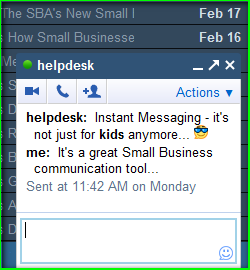
Instant Messaging

If you’re like most Small Business owners or operators “of a certain age”, your view of Instant Messaging, if you have one, may be similar to one of the following statements:

  1. Instant Messaging is for kids
  2. I have an email account – what do I need messaging for?
  3. It’s too complicated
  4. I don’t have time for that nonsense
  5. What good could this messaging stuff do for my Small Business?


I’m sure most of you reading this can relate to at least one of the statements above; the last one asks the question is, in fact, the topic of today’s post.

Business, as I’ve mentioned in the previous series, is about relationships. Relationships, in turn, are about communication. I’m sure it’s no secret that email is an essential Small Business tool — if nothing else, it has allowed Small Businesses to save on postage and shipping costs once required to provide instant communication. Where it once took a special delivery or overnight package delivery (and still took at least a day) to ship critical documents to a business partner, vendor or client, we can now attach a PDF or word processor file to an email, and the relevant party receives it almost instantly.

Thus the “instant” in instant messaging — “IM“, as it is commonly known, combines the quickness of a phone conversation with the permanence of text. This second component is not to be overlooked, or taken lightly. How many times have you spoken with someone about a previous conversation, struggling to recall an important detail that neither of you can remember now, because you weren’t recording the call or taking notes?

IM-ing is nothing but taking notes, real-time, as you engage in conversation. Even with a stenographer on hand, you would still probably miss much, and usually only capture your side of the call. With IM, the transcription IS the conversation and, in addition, you have the benefit of:

  1. Including links to relevant websites
  2. Transferring electronic documents and digital images
  3. Copy-and-pasting information from emails and existing documents
  4. Creating a “paper trail” for reference and auditing purposes


In addition to these benefits, IM helps reduce the occurrence of  ”foot-in-mouth disease“: since you type your responses before you transmit them, you have a few seconds before you click “Send” to decide if you want to forward what may amount to an emotional outburst, rather than a well-chosen response.

Google and Yahoo! have standalone chat clients and clients built into their emails; Facebook and MySpace accounts have built-in chat as well. Blackberry, Android and iPhone smartphones all have apps that aggregate all your chat clients into a single location, allowing you to appear online to all your various chat partners.

In addition, there are stand-alone chat tools such as MeeboCitron and ICQ that do the same thing from your desktop. Being able to communicate with your Small Business clients, partners and vendors as quickly as a phone call, with the permanence of text, the ability to embed web links and transfer files may be a novel concept to you, but you must certainly appreciate the possibilities it presents.

Consider it from the perspective of business objectives, not just technology. The strategic business advantages should be quite obvious — if you’re getting the message.


Cornell Green is Your Solopreneur IT Expert, guest blogger for KikScore. Visit him at http://opensourcecio.blogspot.com

Related articles

Enhanced by Zemanta

Post to Twitter Tweet This Post

  • Share/Bookmark


Archive for the ‘Small Business’ Category

Leave No Business Behind: Pearls of Wisdom for Every Startup & SmallBiz

Wednesday, February 8th, 2012

A few years ago we were just a couple of entrepreneurs with an idea that we felt could solve a pressing issue for small businesses.  No one really knew us and in many ways no one should have known us then since we were just starting out. Thus we had little to no street credibility.

There is a funny thing that happens as time passes (besides me longing for those care-free college days where the toughest decision was Burger King, KFC or pizza for dinner tonight?).  As the clock ticks away you gain valuable experience and insight about life, growing a startup business, the team and people around you, the market, trends, dealing with your customers and partners and for us building a product that enables small businesses to show that they are trustworthy and credible.  The experience translates into knowledge.  Therefore we continually make it a priority for our team to share with the small business community the knowledge we have gained through ups and down, good times and challenges and those inevitable growing pains all businesses must endure.  It is our way of helping the startups, small businesses and the greater community. That is frankly one of the reasons we interview our own customers so they can provide their knowledge to all of us.

So we just wanted to take the time to highlight some of our knowledge sharing we have recently done. This has been through blogs posts on some really great small business focused sites.  We, at KikScore, were very excited to be invited to provide guest posts at two fabulous and prestigious SMB focused blogs.  First is Ivana Taylor’s awesome DIY Marketers Blog.  Ivana is such a force and inspiration for small businesses (though I have to ignore she is a Steelers fan! See earlier post on my feeling toward “those fans.”).  We were truly honored to be invited to contribute to her fast growing blog. Ivana by the way has some great things launching for 2012 so please be on the look out for them.  The second is the majorly popular and growing .CO Blog called Go.CO.  Again being specifically recruited and asked to contribute to this fantastic blog has been an honor.  So we keep working hard to contribute KikScore’s thought leadership on small businesses, operating a startup, setting, creating and managing strategy and also steps to effectively market your business.

Here are links to some of the posts if you would like to check them out:

1. Are you looking for ways to use videos in your startup or small business, if so check out  5 Types of Marketing Videos Every Small Business Should Use.

2. We each face the challenge of how do we build a brand with all of the “noise” out there, here are 4 Steps to Developing a Small Business Brand.

3. Wondering how to show website visitors you are trustworthy and credible check out The Online Trust Issue – Tips to Find the Right Trust Seal for Your Small Business.

4. As we get rolling into 2012, take a step back and review these 5 Steps to Make 2012 Your Best Year for Your Business By Learning From 2011.

5. If you are looking for a path to acquiring and maintaining loyal customers here are 6 Ways to Make Better Connections with Your Customers By Paying More Attention.

6. We are living in a LinkedIn world now so make sure you are taking advantage of every opportunity to use your connections with these  Steps to Use Your Professional Network to Grow Your Business.

7. A lot of small businesses and startups just want to stick their heads in the weeds and get things done, but every business needs to take a look at these Business Strategy Tips for Small Business Owners.

8. As we all look inward at our own startups and small businesses and how we manage our teams, we can use these 5 Skills & Traits Every Entrepreneur Should Nurture for Success.

9. With everything that is on our plates for our respective businesses here are some important Steps on How to Cut Distractions & Focus More On Achieving Your Business Goals.

Well we have had quite an active few months blogging on these great small business sites.  Many thanks to each of the sites for having us and we look forward to providing more guidance on a range of items in the future.

Post to Twitter Tweet This Post

  • Share/Bookmark


Archive for the ‘Small Business’ Category

Some Recent Highlights of KikScore Making News

Monday, January 23rd, 2012

We just wanted to highlight a bit of the coverage we have received recently and send out a special thank you to those great folks that took the time to cover KikScore.  As you all know we are a bootstrapped startup so we do not have any real budget for PR so all of our PR efforts are self-generated and the coverage has been really organic.  In all honestly it has been pretty cool to see our efforts get recognized by some of the most respected sites in our industry.  Now that I think of it,  I will follow up with a blog post in the near future on how startups and small businesses can generate their own PR and increase their chances of being covered.  I think there are some nice lessons learned and some tips from our own experience and I will be happy to pass that along to the community.

Here is some of the coverage:

1. How to Give Online Shoppers Confidence in Your Website at SmallBiz Trends.   Special thanks to the always awesome and fabulous Anita Campbell for this fantastic piece that covered us.

2. Trust is Critical When You Date, Bungee Jump and Sell Online on Business Insider.  We have to give a special thanks to the man who has endless energy, passion and drive for all things small business, Ramon Ray for this write up.

3. KikScore Named Best of 2011 SmallBizChat Interviews by the SmallBiz Lady.  Melinda Emerson who moderates that super informative #SmallBizChat every Wednesday on Twitter from 8-9pm named KikScore as one of the top 10 chats of all of 2011 and put us in the same company as Anita, Guy Kawasaki, Tai Goodwin and Pierre Dubois who also made this prestigious list.

4. KikScore Online Trust Survey Finds Information Sharing Leads to More Trust at the fast growing startup blog TechCocktail.  We have to send a special shout out to Frank Gruber, Jen Consolvo and Shashi B at DC-based TechCocktail for this great write up.

5. Launch Story: From Business Affairs & Legal Executive to Ecommerce CEO at one of our favorite sites Launch While Working.  Thanks to the amazing Tai Goodwin for this write up and for all the support she has given KikScore.  Please make sure you look out for her book that every person who works in Corporate America should buy and then read – The Employedpreneur Plan: How to Launch Your Business Without Quitting Your Day Job.

We hope to keep up this pace of having KikScore in the news, but for this go around we send out our incredible gratitude and thanks to the great bloggers and websites that covered KikScore over the last few weeks.

Post to Twitter Tweet This Post

  • Share/Bookmark


Archive for the ‘Small Business’ Category

Small Business Interview with Hostile Bacon

Thursday, January 19th, 2012

I had the opportunity to interview Miss Ren & Pete who operate an up and coming Shopify store named Hostile Bacon this week.  They had some very interesting lessons learned from their experience starting their business and how they have evolved their use of social media to help market their business over time.  Please check out the interview below and let us know your thoughts in the comments as well.

Tell us about your business and who you focus on serving?

Hostile Bacon is an online store that provides a variety of products that are unique or quirky in nature. These are lifestyle and fashion items that you typically wouldn’t find at the local shops, some items are handmade by local designers, others are sourced from overseas and closer to home. We also provide random yet interesting information through Ren St blog and our social media channels.

Our focus is to serve anyone who likes things that are a little bit different, a shopper who is looking for a gift for themselves or someone else. If you’re nostalgic, whimsical, fashionable, health conscious, practical or all of the mentioned, Hostile Bacon is for you.

How did you get started selling online?

www.hostilebacon.com.au came about by necessity. I’ve been designing and making things since I first stepped foot in a home economics class room many years ago. At the start I was making things for myself and then friends and family started putting in orders and then eventually friends of friends were buying my designs, by this stage online was the best medium to have as a shop front and I also started sourcing products to provide a larger variety.

What inspires you to grow your business?

I really enjoy sourcing new products, coming up with new ideas, researching and writing my blog and seeing what so many talented designers are producing. I’m also inspired by the fact that we provide a good shopping experience for our customers. Shopping should be an activity that is pleasurable and easy.

If you had 2 lessons learned from your business that you could pass on to others about selling online, what are those?

Lesson number 1 would be to invest in a reputable, secure hosting company, to keep your site operating securely.

Lesson number 2 is to remember that little things make a big difference. Wrapping an item, replying to a post or comment, these things and more, create a good experience for shoppers and potential customers.

Where has your business focused most of its energy this year?

This year we’ve focused on sourcing new and interesting products and optimizing the website to attract and maintain customers. We want to be found easily and for our customers to come back repeatedly and to do this we have to offer something new regularly and provide a reason to come back to the site.

What do you see as 2 new trends in for small business and in your business?

I believe more small businesses will use social media to engage rather than push products. We’ve built social media into our marketing plan as a majority of our target market are social media savvy.

A user friendly website that is clean and easy to navigate is becoming more favoured, long gone are the days of clunky websites with neon flashing banners and an encyclopedias worth of information. We regularly make changes to the site to ensure those that do visit have a good experience and stay longer.

If your business/store could be any movie or movie character, what movie/movie character would it be and why?

I would choose the character Holly Golightly played by Audrey Hepburn in Breakfast at Tiffany’s as she is synonymous with style, glamour and eccentricity.

If your business could have a dream spokesperson for your company who would it be and why?

Fonzie would the our dream spokesperson, he was cool in 1974 and 38 years later he is still cool.

What is the biggest challenge that your business faces as a small business and how do you work to overcome that challenge?

A big challenge is competing with large companies with even larger marketing budgets.  To overcome this we will continue with traditional marketing activity and provide our customers with a great experience so they ‘market’ us to friends and family.

Do you have any parting thoughts for our readers and the small business community?

You are the expert in what you do so rely on experts to perform tasks in other areas to help you with your business, things that may not be your strengths. It’s very easy to become bombarded with tasks in running a business and sometime it would be a much more effective use or your time and resources to utilise someone else’s skill set and lastly, enjoy what you do. I’m always smiling when I talk about Hostile Bacon because I enjoy it so much.

Post to Twitter Tweet This Post

  • Share/Bookmark


Archive for the ‘Small Business’ Category

Some Small Business Resources and Tools for 2012

Tuesday, January 17th, 2012

It’s only the 3rd week of the new year (can we still call it that?), but it’s time to start thinking of tools you can use for your small business in 2012. There are plenty of tools out there, but we’re only going to talk about a few. (These may be considered resources more than tools.)  These will be useful as a good starting point and then you can find more tips, tools and resources through them.

  1. Twitter chat! To me Twitter almost seems like a chatroom, only with a word limit and hashtags. If you want that chat feel, then you can attend #smallbizchat on Wednesdays at 8pm on Twitter. This is hosted by Tai Goodwin and Melinda Emerson. These one hour long chats are great for getting great guidance from experts about your business.  The hour usually keys on one area that relates to owning, operating or growing a small business and features a fabulous expert that dishes out gems while an audience of participants interacts with the expert and also each other.  Its a fun hour to get a lot of good guidance.
  2. Women Grow Business -yes even if you’re male. Why? This blog offers a different and unique perspective that applies not only to women, but to men as well about being an entrepreneur and dealing with the issues that small business owners face.  Several good contributors and editors on this great blog including the always fabulous Tinu Abayomi-Paul, Shonali Burke and Jill Foster.  And there are so so many more.  They also host tweetchats too (once a month) that are also very valuable to participate in.
  3. Inc. Magazine- this is a great resource and Raj has written a superb post about it. This magazine is geared specifically for Small Businesses and has excellent articles with very practical advice.  This is a must have and should be a mandatory monthly read!  The articles will get you excited and motivated to do great things!
  4. SBA. gov- this site is run by the government and looks a lot cleaner than most government websites. It’s very through and has both general and local resources across a range of issues such as financing, tax, incorporation issues, selling and buying online etc.
  5. Small Business Trends- This site has tons of great resources and information for small businesses. It has guides, sections devoted to Management, Marketing, Funding and even one devoted to Research. Plus, the founder is the amazing Anita Campbell. :)
  6. SME Toolkit- This is a website made by both the IFC and IBM. It’s “designed for Asian, Black, Hispanic, Native American and Women-owned businesses” , but it has useful information for everyone.
  7. Small Business CEO-  This is more of a guide to management for small business. If you’re just starting out, then it probably won’t be of much use to you, but if you’re looking to add employees and grow your business, it’s worth a look through.
  8. Small Business Technology- this is a blog that talks about news and technology that’s related to small business. It explains how and why the latest pieces of tech or news can matter to small business. Plus, my father apparently likes it on Google plus so it has to be a good resource!
  9. Constant Contact- Unfortunately, unlike the other links, this one is a paid tool. There is a 60 day trial though. This tool helps you keep in touch with your clients via email marketing and social media marketing.
  10. Business. com- Whatever field you decide to start a small business in, they’ll have resources for you.  There are literally guides on almost anything you can imagine related to a business.  Instead of doing a bunch of Google searches on a subject related to small business, check out this great site first and you likely will save yourself some valuable time.

These are some great resources to start you off with now. From these, you can then branch off using the links that they provide to find even more resources that would fit your needs. There are plenty of resources out there and these are some of the best I have seen lately.

Are there any others you can think of and want to share with us?

Post to Twitter Tweet This Post

  • Share/Bookmark


Archive for the ‘Small Business’ Category

Learning from the Past: KikScore’s Top Twelve Blog Posts of 2011 for Small Businesses and Startups

Wednesday, December 28th, 2011

It’s been a great year for KikScore! We’ve gained partners, garnered press, interviewed tons of great startups, and released our first white paper. Sounds like a winning year to me. That’s why we put together a list of our top blog posts for 2011. By highlighting some of our beloved posts, we can reflect on what KikScore has accomplished through the year as well as go over some information that we believe is important enough to bear repeating for small business. We hope you enjoy!

#12: 5 Ways to Develop a Killer Brand for Your Small Business and Startup

If you are looking to establish a good brand name for your business, then this post is for you. Although it’s daunting to see big businesses with huge budgets for marketing and advertising, there are cheaper and more effective ways to build your brand. This post goes over the different ways in which you can deal with your customers and make their experiences so great that your brand will practically build itself.

#11: 7 Questions A Small Business or Startup Should Ask Themselves Every Day

It’s critical to ask yourself important questions. Even if it is just to make sure that you know the answer instead of just thinking you know the answer. This post discusses several questions that you need to ask to make sure that your business is headed in the right direction.

#10: The Day in Pictures & Tweets at the 2011 SmallBizSummit

Just as the title says, this post is a compilation of pictures and tweets from the 2011 SmallBizSummit. Here you can find great quotes and images that focus around how all small businesses should act and what they should do. Take a look and feel like you were there yourself.

#9: 5 Reasons that Startups & SmallBiz Must Engage Their Customers

If you think that this list is already beating up the idea of paying attention to customers, then you aren’t thinking like a business should. This next post builds upon the ways to really engage customers and see results. Give it a read and try the advice for yourself. We promise you won’t be disappointed.

#8: Web Design Contracts – Protect Yourself & Your New Business

This guest post, written by Gregg Hand, is of vital importance when preparing to set up a website. We’ve all heard the speech about why we have to read the fine print before signing a contract. However, now that you’re helping to make a contract with a web designer, you must be twice as cautious. If you’ve never had to make this type of contract, this post can help you with a set of helpful advice on what to look out for.

#7: Top Ten Reasons Small Businesses Fail Series

(Procrastination; Competition; Marketing; Clients; Employees; Versatility; Location; Cash Flow (Followup); Closed Mind; Planning)

Here is a series of posts that we’ve worked on throughout the year in an effort to help small businesses understand what they must avoid. Some say that learning from the past is one of the best ways to prevent certain future events. There’s at least some truth to this saying, so we hope that this series will help your business avoid the easily avoidable.

#6: KikScore SmallBiz Interviews’ Greatest Hits & Top Strategy Tips for Entrepreneurs (Part I and Part II)

These posts use quotes from businesses that KikScore has interviewed in the past regarding lessons they’ve learned and challenges they’ve faced. Each quote has years of experience in ingrained in it, so they’re worth the reading.

#5: Championship Sports Teams…What Do They Teach Us for the Small Business & Startup Arena

Bringing together two seemingly different dynamics, this post talks about how the NBA’s Dallas Mavericks and the NHL’s Boston Bruins’ respective teamwork reflect how teams in small businesses must act. Just as in sports teams, the members of your business must be willing to work together and take risks. Take a look and see for yourself just how true this is.

#4: 3 Tools for Boosting Your Business’ Image

This post goes over some tools that all businesses can use, so we think it is worth making the cut. Each tool is free and KikScore utilizes all of them. What are they, you ask? Well there would be no point in referring back to the article if we just said it here, so you’ll just have to look at the post for yourself.

#3: Nonprofit or Going for Broke: Ways to Demonstrate Your Business is Legitimate & Trustworthy

Rather than discussing all small businesses, this post gives advice to nonprofits. Whether for profit or not, all businesses suffer from trust issues. If you are having issues with your nonprofit or even just looking for a way to make it better, this post can help.

#2: #SmallBizChat Highlights – Tips on How to Make Your SmallBiz Website Look Trustworthy and Credible

Here we recap our great experience of being the guest of honor for #SmallBizChat on Twitter. It was a great way for us to take and answer different questions about how small businesses deal with online trust. A slideshow is included in the post, so feel free to check it out.

#1: Shoppers Trust Businesses Who Share More Information – KikScore Online Trust Survey Finds

Another important hallmark of KikScore’s year is the recent issuing of our first white paper, which is discussed in this post. It took a lot of time and a lot of research, but it came out great. If you are interested in online trust and how it impacts small business, take a look at this post and KikScore’s white paper.

We’ve had a great year all-in-all and we anticipate that 2012 will be even better! We appreciate everyone who has worked with us and taken the time to help us this year and we hope you all have a great 2012!

Post to Twitter Tweet This Post

  • Share/Bookmark


Archive for the ‘Small Business’ Category

Shoppers Trust Businesses Who Share More Information – KikScore Online Trust Survey Finds

Wednesday, December 14th, 2011

We are excited to announce our first KikScore Online Trust Survey.  Since we are a business that serves the small business community we wanted to learn first hand what shoppers and website visitors are saying about their browsing experience, especially how it relates to small business websites. The KikScore Online Trust Survey provides an overview for small businesses, shoppers and the greater community about trust and reliability trends. It especially focuses on how consumers approach the trust and credibility issue as they perform local searches for small businesses in various search engines.

The Context and Background for the KikScore Online Trust Survey

Really since the inception of the internet, small businesses have faced the constant challenge of proving that they are trustworthy and reliable online businesses and website visitors should trust them.  Lacking the large marketing budgets and brand names, small businesses face the battle of demonstrating to website visitors that they are legitimate and trustworthy businesses.  This online trust challenge has resulted in billions of dollars in losses for small businesses.

Recently, to add to this challenge that small businesses face is the rise of local search.  As more consumers perform local searches on Google and Bing, search results are returning more and more small local businesses.  Website visitors have the increasing opportunity to visit small business websites of plumbers, realtors, contractors, lawyers and local stores such as dry cleaners and transact on many online small business websites.

We set out to study what are the trends for shoppers as well as small businesses for demonstrating trust through both local search and online shopping.

The KikScore Online Trust Survey & Report Findings

Here are some of the key findings from our report:

  1. The fear of being defrauded or a victim of an online scam has led more than 90% of consumers that shop online not to complete a transaction;
  2. 87% of website visitors feel safer buying from websites that feature information about the business and the track record of the business;
  3. 85% of website visitors that perform local searches are more willing to hire a small business service provider that has a trust seal on their website;
  4. Over 60% of website visitors are more likely to buy from a website that posts information and details about the management of an online business; and
  5. More than 90% of website visitors that perform local searches are more willing to trust a service business that posts information on their website about their business history and track record.


Key Implication from the Online Trust Survey for Small Businesses – More Information Means More Sales

The main takeaway from the Survey is that website visitors want to know who is “behind the online business” and information about the business itself.  Further, the data indicates that one way to combat the online trust challenge for small businesses is to address the information asymmetry that exists between website visitors and small businesses.  The recurring theme through the data from the report is that local searchers and shoppers want transparency through reputational information when they reach a small business website. This finding tends to makes sense from a layperson’s psychological approach to approaching something unknown.  From a human relations perspective, once a person finds out more information about a previously unknown subject/person, that person then can make a much better assessment about the credibility and trustworthiness of that subject/person.  The same approach generally holds true for a website visitor to an unfamiliar online business.

From this key finding, the KikScore Report provided these following recommendations for small business to act on to start addressing the information asymmetry:

  1. Start providing key information about your small business on your website;
  2. Important information to provide can include, details about the management team, financial history, location information, website history and security information, customer service and privacy policies, certification and awards and introductory videos;
  3. Display real customer feedback and testimonials about a shopping experience or your customer’s experience hiring your small business to provide a service; and
  4. Using and displaying a trust seal(s) that help you show website visitors that your business has been validated and provides information about the reputation of your small business.

The important point for small businesses from this report is to use these four steps outlined immediately above as a way to use information about your own business, your management team, your own track record and make that transparent to website visitors.  These steps will help small businesses address the online trust challenge and directly help balance the information asymmetry between website visitors and small online businesses.

Case Study: PaybaQ Proves the Importance of Displaying Reputational Information

As a part of the Report, KikScore included a case study from a small business that had already implemented the recommendations above to provide an illustration of how one small business owner successfully tackled the online trust challenge.  The case study is of Brian J. Esposito the CEO and founder of PaybaQ.

Shortly after launching PaybaQ, a peer-to-peer lending site, Mr. Esposito faced low signups, abandoned shopping carts and abandoned registrations.  Mr. Esposito, being a prior Inc5000 listed business owner, sought to use his own reputation as a way to show website visitors his website was trustworthy and reliable.  After Mr. Esposito signed up for KikScore and started using the KikScore Confidence Badge to provide more information about his track record as a business owner and also offer a way to provide feedback, PaybaQ experienced a 20% increase in conversions.

As seen from the increase in PaybaQ’s conversions after using the KikScore Confidence Badge to display reputational information about the business owner, management team, website and policies, information transparency is the fundamental method for small businesses to demonstrate trustworthiness and achieve success online.  Mr. Esposito noted: “Immediate access to information and transparency into any company is crucial, especially startup small businesses.  Implementing a seamless solutions on PaybaQ.com gives my potential users exactly what they need, a quick snapshot of my company, team members, and even myself.  This tool helps show browsers who find our site through Google and Bing that they are on a safe credible site that they can trust.”

Post to Twitter Tweet This Post

  • Share/Bookmark


Archive for the ‘Small Business’ Category

Mobile Shopping is Going Viral this Holiday Season!

Tuesday, December 13th, 2011

With only 11 shopping days left until Christmas, shoppers need all the help they can get this holiday season while trying to find the best deal on the perfect gift for their loved one.  This year more shoppers than ever before are using their smartphones to find the best deals while they are in stores around the country and even at home and work.

Pricegrabber just released these survey results last week of 3,574 online consumers in the United States.  According to these results, 39% of all respondents have a shopping-related application on their smartphone.  Out of the respondents with a shopping application on their phone, 56% indicated that they have these applications on their phone because they believe they get the best prices using mobile shopping applications.

These numbers show a staggering increase from just 1 year ago when I wrote this KikScore blog post that talked about a Wall Street Journal article that indicated that only 5.6% of consumers used a mobile phone to price compare while on the go.  The WSJ article referenced in the aforementioned blog post also says that only .1% of consumers used a mobile phone in this way in 2009.  As you can see from these numbers consumers are continuing to increase their use of smartphone mobile shopping applications at an exponential rate!

So, what are merchants across the Unites States doing in response to these legions of mobile smartphone shoppers?  Unfortunately, the answer is still “not very much” at this time.  Again, like I mentioned in my blog post last year, I still cannot walk into a Best Buy, use my smartphone to find a better price on an item online and get the store to match this price.  Many bricks and mortar stores are still having a problem reacting to this new wave of technological advancement in the pocket of the U.S. consumer.

According to this article in the Chicago Tribune, some retailers like Macy’s and J.C. Penney are starting to react to these mobile shoppers by streamlining their mobile websites, creating custom shopping applications, and increasing the speed and efficiency of their sites.  In my mind, however, this is just the very basic levels of catering to the mobile shopping consumer and great strides will need to be made in the coming years in order for this new bread of consumer to be on the same page with these large retailers in the U.S.

Have you had a positive or negative experience while using a smartphone with a mobile shopping application at a retailer?

Post to Twitter Tweet This Post

  • Share/Bookmark


Archive for the ‘Small Business’ Category

Reach Your Best Insights! A SmallBiz Interview with Pierre DeBois

Monday, December 5th, 2011

Today’s KikScore interview features Pierre DeBois, founder of Zimana, a web analytics service. In this rapidly changing e-commerce environment, Pierre is instrumental in helping other small business reach success through his analysis of their web analytics and his assistance and advice for marketing and social media strategies. I had a pleasure talking with Pierre and learned a lot, so I hope you all share similar benefits from reading what he had to say.

Tell us about Zimana and who you focus on serving?

Zimana is a web analytics consultancy service for small businesses that are at a unique stage of operations, having launched their businesses that rely on analytics data. These businesses require marketing optimization but do not have enough time determining their marketing effectiveness and aren’t ready to reach a larger analytics firm. I analyze their analytics data, ranging from basic keyword analysis to website traffic exploration, and then I help them develop an optimizing marketing strategy with projections. My clients encompass a wide array of small businesses, from mom and pop companies to businesses that built their firm around a particular platform with numerous employees.

What prompted you to start Zimana?

It was very accidental; my original idea was that I wanted to work with small businesses that needed help with their financial data.  I found out that a lot of the time these businesses tend to seek financial help, but it’s often too late to implement the advice. Therefore, that doesn’t strike me emotionally as a way to be helpful. So back in 2007, I was working for a government contractor firm in Huntsville, Alabama. The firm was determining if potential clients were reviewing products and services at the company website. I researched and discovered the measurement solution Google Analytics. I used my own resources and vacation schedule to undertake the training on my own. I then worked with the web developer to implement site content changes. The end result was successful and identified traffic flow through the site. It helped the firm place a value on their marketing budget. That was my first taste of web analytics though it wasn’t until 2.5 years ago when I launched Zimana. It’s been great and fun, though still very challenging especially due to the economic environment we are in. But the responses have been positive.

What was one of the biggest challenges you faced and how did you overcome it?

Living in New York is a catch-22; though it is the best place to meet and network with people and find good resources, it is economically straining to live here starting out.  It is also tough to follow up with customers in the actual city, as opposed to other locations. When living and working here, you learn how resilient you have to be and it forces you to be efficient. While the fast-paced, business environment makes it hard to initially make a living, it forces you to remain focused and more diligently.

As a hub for business, being centered in New York also allows me to track clients outside of New York; one of my best clients is SmallBizTrends.  Though based in Ohio, I conduct a lot of their monthly analysis. Moreover, being in NYC has helped me to create many business book reviews for the book segment and provide up-to-date analytics ideas that will be beneficial for their future.

How do you advertise yourself to get more clients?  Do you make use of tools like social media?

Yes. Social media has helped me tremendously, especially through Twitter as I have attracted some of my followers through my tweets. In addition, though accidental, my writing has had a huge influence on gaining more clients. What started as being just for fun doing book reviews evolved into writing analytics articles.   I’ve written articles for many different business sites, including AllBusiness.com, Pitney Bowes Smart Connections series, Business Agility, and AllAnalytics.com.  The posts have helped me a lot, expanding my online exposure and clientele base. A great challenge has been balancing my time for writing and managing other business functions. I had not expected the writing to take the direction it has.  In general, client referrals and social media marketing have been the most beneficial for me, with carefully placed and timed ads as bonus exposure. I am a big believer of using analytics to figure out which marketing outlets actually work, so that has helped me tremendously of where to focus most of my attention.

Have you had any trouble proving your business’ credibility and legitimacy to potential customers and website visitors?

Yes, there have been times and I think it’s in a very weird catch-22. In my business, the accountability issue is in the beginning; there are certifications that analytics practitioners must take and my qualifications definitely help. Though at the same time, there is a level of education that is required on part of the customer. The main customers believe that analytics is only for SEO and that’s not the entire case. So the challenge becomes that an analyst can be used for both online and offline marketing functions, though it depends on the organization, and therefore I must educate the customer enough and provide them with enough information that they will be comfortable doing business. Sometimes it works and sometimes it doesn’t, but most times people are appreciative of what you try to share with even if they don’t quite have the budget.

In terms of being legitimate, what’s helped me is dealing with the right customers and not trying to deal with those that are uninterested. Only once or twice have I had to deal with a relationship that wasn’t right, but as a business owner, you have to hold out and fight for the ideal customer. Once you find the right one, then credibility will come into play. The use of social media can be utilized to reinforce that credibility; in order to effectively use social networks, you have to focus on keeping in touch with specific people and make the most of the contacts that you have made.

Based on your expertise, what two things do you think small businesses should be doing concerning online marketing?

First, there needs to be more of a coordinated effort between digital properties (websites, paid searches, social media) and how you market your business offline. There are now studies that are proving that when you gain a customer, that customer has researched your business online and then decided whether they will do business with you. Lots of small businesses do not coordinate their online and offline efforts well, but they need to think holistically about how they market themselves and then track that, which is where the analytics comes into play.

Second, based on my expertise, businesses need to begin thinking about more than search engine optimization. With the emergence of social media, there is more of a need for a combination between social media and search, plus some level of digital marketing, whether it is paid ads on Google or banner ads on Facebook. There needs to be an increased effort beyond search to touch upon the customers and engage them. Businesses are aware of Twitter and Facebook and other networking communities, though they often do not make a dedicated effort to effectively use them. Going beyond SEO, some type of paid search or ad, coupled with social media, will help businesses convert customers on the sidelines as an ongoing customer.

What trends do you see in the business world that you think are important for small businesses to take note of?

A rising trend in the small business world is the use of cloud services. I support these services whole heartedly because it makes it easier to manage a team, whether you’re an army of one or 20. They create value for the services you have and permit more efficient management. I’m finding that the businesses that struggle have not thought in terms of simplicity; For example, one business never thought of instituting PayPal on their site because they didn’t use credit in their operations.  That doesn’t mean that your customers don’t. Most businesses are too focused on their main product or service and therefore they do not think about all the underlying activities that would be essential. You don’t need to have a desktop to quickly search for information, so the challenge for small businesses is not only having access to up-to-date technology, but deploying it in the best and easiest manner for conducting your business.

Speaking from personal experience, the people who helped me the most were freelancers. One lady designed my website and also developed my hand-drawn logo into something very unique. Another was a photographer whose photos of me grabbed the right attention. I learned many different tips from many sources, ranging from billing ideas to learning to focus on the big picture as opposed to the little details. The biggest thing is to learn from others how to conduct business efficiently, so you are working to grow your business and “on” your business, not just “in” it.

How do the folks at Zimana let loose after a busy day working?

For me, I’m a big fan of The Big Bang Theory; I love it and think Sheldon is hilarious and the best television character in years. I watch a little Big Bang Theory and football, and I’m good! I still love automobiles like I did growing up so I read up on cars quite a bit. Pretty much besides that, I just try to keep up with my close friends and family. I haven’t had as much time to relax as I’d like to and for the most part, my business is my time. In addition, I talk a lot with other small business owners, which is both informative and also energizing.

Do you have any parting thoughts for our readers and the small business community?

Stay driven and keep your faith. If you are in any struggles, keep your faith and make sure every day spent on your business is actually productive; business owners spend too much time talking about their business, as opposed to working on it and helping it grow. Using your time efficiently is necessary, as well as networking and making sure that you are learning what needs to be learned to stay current with your business and surrounding technologies. At the end of the day, you need to be driven to put all of the pieces together and keep your business moving into the future. 

Post to Twitter Tweet This Post

  • Share/Bookmark